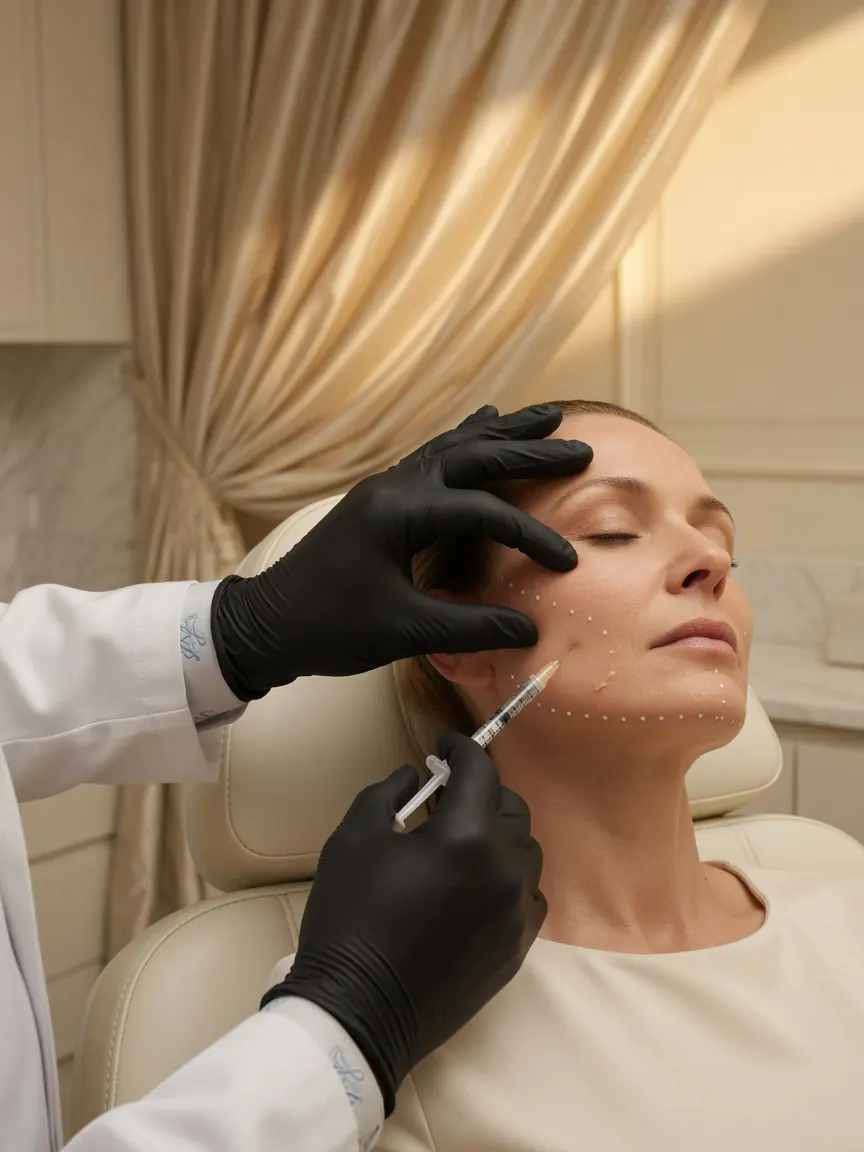
What non-surgical rhinoplasty is and how it works
Hyaluronic acid is a biocompatible filler that restores volume, hydrates deeply and harmonizes facial proportions. Applied to the nose with sound judgment, it makes non-surgical rhinoplasty possible: no tissue is removed and no bone structure is modified. Instead, small amounts of product are placed at the points the physician defines during the assessment.
The underlying idea is to harmonize, not to reduce. By working areas such as the bridge, the tip or the nasal angle, the way the nose reads from the front and in profile can change, with immediate results and without an operating room.
The same material is used in the lips, cheekbones, folds and chin, and it also allows facial tightening. That is why the nose is usually planned within a broader facial harmonization.
Who it is indicated for, and who it is not for
In well-selected patients, rhinoplasty with hyaluronic acid is usually considered when the goal is aesthetic and about proportion. Some frequent reasons for consulting:
- Wanting a more harmonious profile without undergoing surgery.
- Balancing the nose with the cheekbones, the chin and the folds.
- Preferring an in-office procedure with immediate results.
It is not the right alternative for anyone who wants to reduce the size of the nose, modify bone structures or resolve a breathing difficulty: those goals belong to the field of plastic surgery. The physician may also postpone or advise against the procedure if the assessment reveals health conditions, medical history or expectations that do not match what hyaluronic acid can offer.
What the procedure is like at Dr. Sandro Florez's practice
Assessment
Everything starts with a medical consultation. Your anatomy, your medical history and what you hope to see in the mirror are reviewed; from there come the plan, the injection points and the amount of product. If your case is not one for hyaluronic acid, you will be told clearly.
Application
It is an in-office procedure. The physician places the filler at the defined points and checks the result from the front and in profile as the session progresses. How long the session takes depends on each case and is estimated during the assessment.
Afterwards
Facial treatments of this kind require no time off and allow you to resume your routine the same day, following the instructions given at the end of the session.
Results: what to expect and when
Hyaluronic acid offers immediate results: by the end of the session the change in proportions can already be seen. During the first few days there may be redness or mild swelling, so the final appearance reads better once that reaction subsides.
Realistic expectations matter. Non-surgical rhinoplasty does not swap one nose for another: it aims for a profile that looks more balanced within your own face, without altering your expression. How far it can go depends on each person's anatomy, and that is discussed before anything is applied.
The result is not permanent either. Its duration varies with each patient and the treated area; the physician estimates it during the assessment and defines, where appropriate, when the result should be reviewed.
Aftercare and recovery
There is no time off required: most patients return to their routine the same day. Redness or mild swelling may appear during the first 24 to 72 hours, which is expected and temporary.
Personalized instructions are given at the end of the session. In general terms, the usual recommendations are:
- Avoid manipulating or pressing on the treated area.
- Postpone wearing glasses or accessories that rest on the nose, as advised by the physician.
- Put off intense exercise, extreme heat and direct sun exposure for the first few days.
- Get in touch about any discomfort that does not subside or that you did not expect.
Following these guidelines helps the result settle as planned.
Why have it done by a physician in Bogotá
The nose sits at the center of the face and is an area with demanding anatomy: the result depends less on the product than on the judgment of whoever applies it. That is why it is worth having rhinoplasty in the hands of a physician trained in facial aesthetics, able to evaluate the whole case before deciding.
Dr. Sandro Florez sees patients at Calle 126 # 7-26, Torre 126 PH-1303, and works with that logic: assessment first, plan second. His focus on facial anatomy and injection precision is covered in this blog article.
Personalizing also means knowing when to say no, or proposing another route among our treatments when that is what the case calls for.
Combining it with other treatments
The nose is rarely assessed on its own. Since the same hyaluronic acid can be used on the lips, cheekbones, folds, under-eye area and chin, plans often include more than one area so the face stays balanced as a whole; facial tightening can also be added when the case warrants it.
Other options at the practice may support the result, depending on what the physician considers appropriate: take a look at the facial treatments section, or the anti-aging approach if you are interested in a medium-term plan. Among men, profile harmonization is one of the most frequent requests, as we describe in this article.