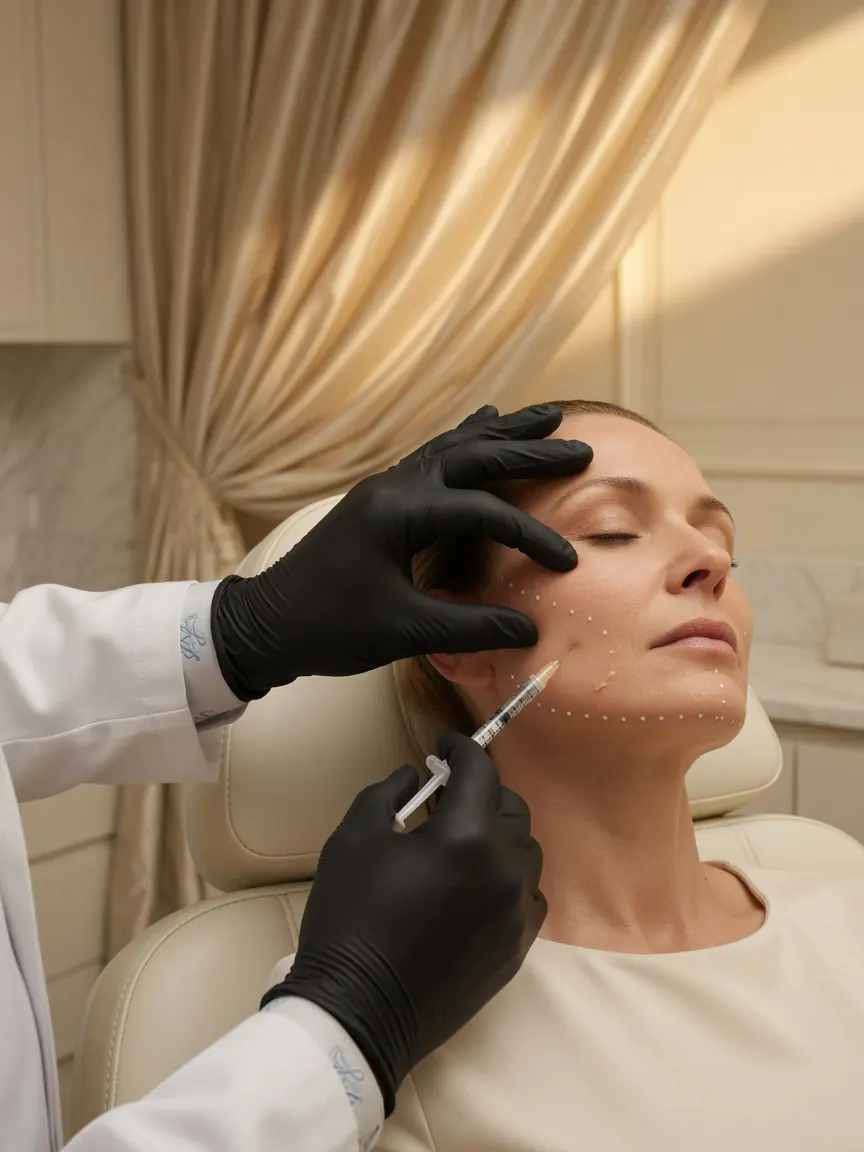
What hyaluronic acid is and how it works
Hyaluronic acid is a biocompatible filler material applied in specific planes of the face. Its action is twofold: it restores volume that has been lost or is deficient in areas such as the cheekbones, lips, folds and chin, and it hydrates the tissues deeply where it is placed.
By restoring support at the right points, it helps harmonize facial proportions: the relationship between the middle and lower thirds, chin projection, lip contour. That same logic of structural support allows two additional in-office uses: non-surgical nose reshaping, to work on the nasal profile, and facial tightening. Changes are visible immediately after the application, although the final appearance is assessed once the initial swelling subsides.
Who it is indicated for and who it is not
It is an option worth considering for patients who notice volume loss in the midface, lips lacking definition or projection, marked folds, under-eye hollows with a volume-deficit component, or who want to harmonize their features without surgery. It also applies to those looking to address aspects of the nasal profile through non-surgical reshaping.
Not every case is solved with filler. When the main issue is advanced laxity, skin quality or a significant structural deficit, the physician may suggest other paths within facial medicine or refer the patient to plastic surgery. It is also not suitable for those seeking a change that would blur their expression: the goal is for the face to remain recognizable. The assessment with Dr. Sandro Florez determines whether hyaluronic acid is the right tool or whether another alternative is preferable.
What the procedure is like at Dr. Sandro Florez's practice
The process has three clear stages:
- Assessment. Facial anatomy, medical history and the patient's goals are reviewed. This is where the areas to treat, the amounts and the exact injection points are defined.
- Application. This is an in-office procedure, performed by the physician at the Torre 126 location, at Calle 126 # 7-26, in Bogotá. Work is done by planes and progressively, reviewing the result along the way.
- Follow-up. The treated area is reviewed once the initial swelling has passed, and anything needed is adjusted.
The length of the session and the number of areas addressed at one time depend on each case; the physician defines this during the assessment.
Results: what to expect and when
One characteristic of hyaluronic acid is that results are immediate: by the end of the session, the change in volume and contour is already visible. However, that first impression is usually influenced by the swelling inherent to the procedure, so the real result is assessed once the tissues settle.
In well-selected patients, what can be expected is a more harmonious face, with restored volumes and defined features, without any change in expression. This is not about transforming the face, but about restoring proportion.
No aesthetic treatment offers guaranteed results or identical outcomes between patients: the response depends on anatomy, tissue quality and the goals that were set. How long the effect lasts varies from patient to patient and from area to area, and it is discussed during the assessment.
Aftercare and recovery
In-office facial procedures usually allow patients to resume their routine the same day. It is common to see mild redness or swelling within the first 24 to 72 hours, more noticeable in areas such as the lips, which subsides progressively.
Post-procedure recommendations are given by the physician according to the treated area and the individual case. In general terms, they focus on:
- Avoiding handling or massaging the area unless instructed to.
- Being careful with intense heat and sun exposure in the first few days.
- Following the physician's guidance on physical exercise.
- Getting in touch if anything does not progress as explained during the consultation.
The follow-up visit confirms that recovery is going as expected and allows details to be adjusted if necessary.
Why have it done by a physician in Bogotá
The outcome of a filler depends less on the product than on the judgment of the person applying it. Knowing facial anatomy, knowing which plane to work in and understanding how much volume each face actually needs is what separates a natural result from an obvious one.
That is why the recommendation is for the procedure to be performed by a physician, in a clinical setting and after an in-person assessment. Dr. Sandro Florez practices in Bogotá, at Calle 126 # 7-26, Torre 126 PH-1303, and builds every plan individually. That approach — anatomy, precision and aesthetic judgment — is the same one behind the recognition you can read about in this article on the TOP BOTOX® Injectors in Colombia. You can explore the rest of the options in the treatments section.
Combining it with other treatments
Hyaluronic acid rarely works alone. Depending on the case, the physician may propose a plan that combines it with other options from the facial portfolio:
- Biostimulators, when the goal is to stimulate the patient's own collagen rather than replace volume. You can read more in this article.
- Skin boosters and skin-quality treatments, to work on luminosity and surface hydration.
- Tightening technologies, such as those explained in the article on Ultraformer MPT in Bogotá.
- Anti-aging protocols with follow-up over time.
The right combination and the order of procedures are defined during the assessment, not beforehand.