What lipopapada is and what it corrects
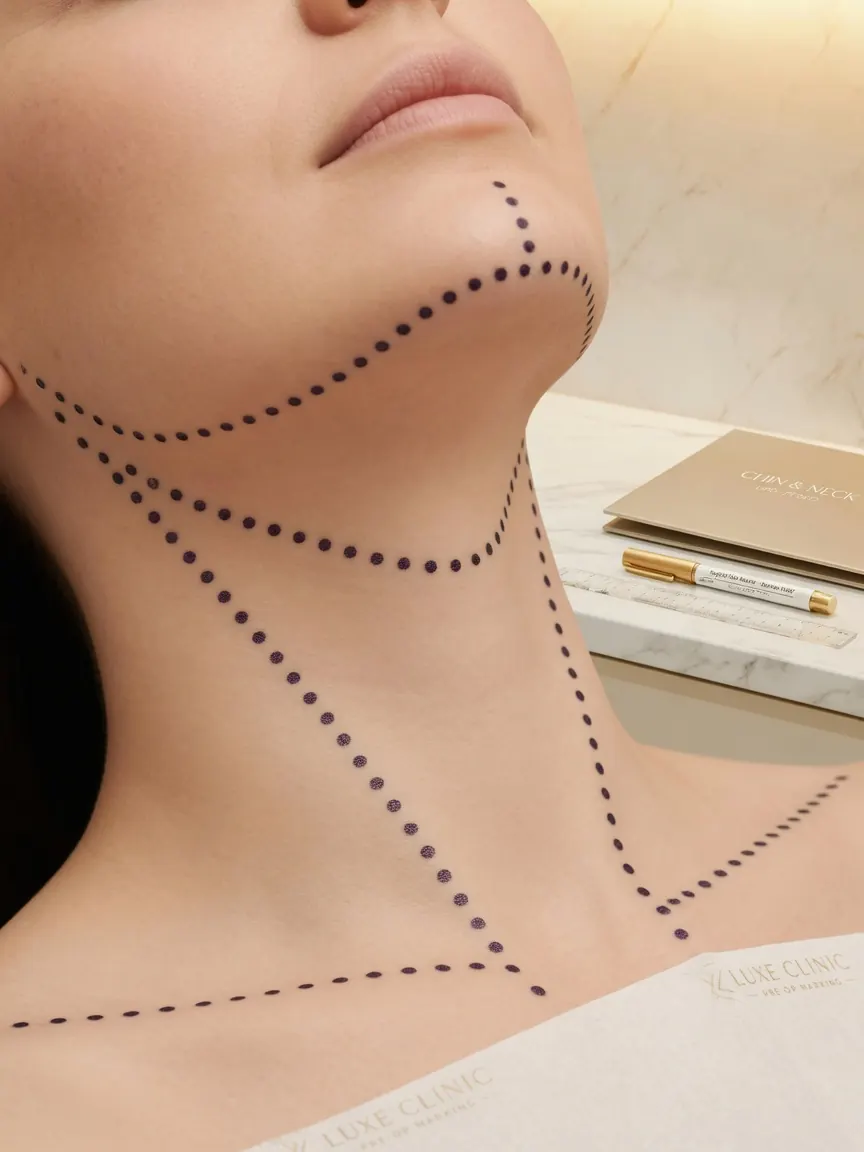
Lipopapada is a surgery that removes, through very small incisions, the fat that accumulates in the submental area, that is, under the chin and above the neck. Thin cannulas are used that allow precise work and gradual reshaping of the contour, protecting the neighboring structures.
It is a procedure focused on a specific problem: localized excess fat. For that reason, what usually improves is:
- The visible volume under the chin, when it looks bulging or rounded.
- The definition of the jawline.
- The angle between the chin and the neck, which gives the sense of a cleaner profile.
It is worth knowing what it does not do: it does not tighten very loose skin by itself, it does not correct prominent neck bands, and it does not change the shape of the chin bone. If your double chin has a fat component but you prefer to evaluate a non-surgical option, you can look into submental lipolysis, which is considered for cases with a smaller amount of fat. At the evaluation, it is decided which alternative best fits your anatomy and your expectations.
Who lipopapada is indicated for and who it is not
The indication depends on your anatomy more than on your age. In general, it tends to be a good option for people who meet these conditions:
- They have evident submental fat that does not go away with diet or exercise.
- They retain reasonable skin elasticity, so that it can adapt to the new contour.
- They are in good general health and have realistic expectations.
- They want to improve the jawline without a more extensive surgery.
In other cases lipopapada is not the most suitable option, or is not enough on its own:
- Very loose skin or prominent neck bands, where a tightening procedure such as a facelift (lifting facial) may be needed.
- A small or recessed chin, where chin augmentation (mentoplastia) may contribute more to the profile.
- Uncontrolled diseases, clotting disorders, or pregnancy.
- Expectations of a transformation that surgery cannot offer.
That is why the decision is made after examining you, and not only from a photo or a message consultation.
What the surgery is like with Dr. Sandro Florez
Evaluation
At the consultation, your medical history, background, and medications are reviewed. Your face and neck are examined, the skin, fat, and position of the chin are assessed, and what you hope to achieve is discussed. If lipopapada is appropriate, the steps, risks, and alternatives are explained in detail.
Surgery
The procedure usually takes a short time, generally between one and two hours depending on each case. A small incision is made, usually under the chin or behind the ears, and thin cannulas are introduced to remove the fat evenly and shape the contour. The incisions are then closed and, in many cases, a compression band or garment is placed.
Afterward
After the surgery, you are given instructions for initial care, use of the band, and the warning signs for which you should contact us. Many people go home the same day, as long as the medical team considers it safe. Follow-up visits are scheduled to check your progress and answer your questions during the first weeks.
Tests, preparation, and anesthesia
Before surgery, preoperative tests are requested to confirm that you are fit for surgery. This usually includes laboratory tests and, depending on your age and history, other studies such as an electrocardiogram. The physician determines which ones you need in your particular case.
Preparation usually includes recommendations such as:
- Reporting all the medications and supplements you take.
- Stopping, under medical direction, drugs that increase bleeding, such as aspirin and some anti-inflammatories.
- Quitting smoking well in advance, because cigarettes affect healing.
- Fasting on the day of surgery, according to the instructions you receive.
- Arranging for a companion to take you home.
Regarding anesthesia, this surgery can be performed with local anesthesia with sedation or with general anesthesia, depending on the extent of the procedure, your health, and your preference, always with medical judgment. During the evaluation, you are told which option is recommended and why, so that you arrive on the day of surgery with clarity and peace of mind.
Recovery and postoperative care
Recovery from lipopapada is usually manageable, but each person progresses at their own pace. In the first days it is normal to have swelling, some bruising, and a feeling of tightness or numbness in the area. Discomfort is controlled with the medications your physician prescribes.
In general terms, this is what usually happens:
- First days: relative rest, use of the compression band, and keeping your head elevated when sleeping.
- First or second week: swelling and bruising gradually decrease; many people return to office activities in that time.
- Following weeks: exercise is gradually resumed, always with the physician's authorization.
It is important to avoid direct sun on the area, not to smoke, and to attend all follow-up visits. If you develop fever, increasing pain, marked redness, or uneven swelling, you should contact the office without waiting. Following the instructions to the letter has a significant influence on how your healing and final result progress.
Results: what to expect and when
Results are not immediate. At first the swelling hides the change, and it is after several weeks that a more defined contour begins to be noticeable. The most stable result is usually seen over a few months, as the edema subsides and the skin adapts to the new shape.
What you can expect, with prudence, is:
- A slimmer submental area and a more defined neck-chin angle.
- A more harmonious profile, in proportion with the rest of your face.
- Natural changes, without aiming for a transformation of the face.
The fat cells that are removed do not return, but those that remain can increase in size if you gain significant weight. That is why maintaining a stable weight helps preserve the result. Aging continues over the years, so the skin will change over time as in any person. If you are also interested in redefining the face, you can also ask about buccal fat removal (bichectomía), which acts on the cheeks and is evaluated independently.
Why have surgery with a physician surgeon in Bogotá
Although lipopapada may seem like a simple surgery, it is performed in a delicate area where important nerves, vessels, and muscles pass. An inadequate technique can leave irregularities, asymmetries, or loss of sensation. That is why it is important that it be evaluated and performed by a physician trained in surgery, in an accredited setting with support to handle any eventuality.
With Dr. Sandro Florez, care starts from a clear conversation: the diagnosis is explained to you, what you do not need is ruled out, and only what makes sense for your case is proposed. It is also worth keeping in mind:
- That the person who operates on you is the one who evaluates you and follows up with you.
- That the procedure is performed in a place with adequate safety conditions.
- That you receive written information about risks and care.
Choosing an office in the city also makes follow-up visits easier, which are an essential part of a good recovery. Be wary of offers that promise quick results without a prior evaluation.
How much does lipopapada cost in Bogotá
It is not possible to give a responsible figure without examining you, because the cost of lipopapada depends on several factors specific to each case. For that reason no prices are published on this page: the most honest approach is to explain what it depends on and specify it at the consultation.
The elements that usually influence it are:
- The amount of fat to be removed and the complexity of the procedure.
- The type of anesthesia used and the participation of the anesthesiologist.
- The place where the surgery is performed and the operating room time.
- Whether it is combined with another procedure, such as a skin or facial contour treatment.
- Preoperative tests, follow-up visits, and supplies such as the compression band.
After the evaluation you will receive a clear quote, with what is included and what is not, so that you can decide calmly and without pressure. If you want to know what your case would be like, schedule your evaluation and resolve all your questions directly with the physician.