What breast surgery is and what it corrects
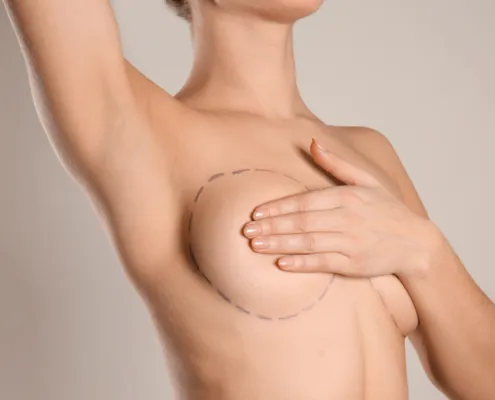
Breast Surgery (Mammoplasty) groups together surgical techniques that reshape the breast. It is not a single operation: the technique is chosen according to what you need to correct.
- Augmentation with implants: adds volume and improves projection or symmetry when the breasts are small, have lost volume after pregnancy or breastfeeding, or there is a noticeable difference between the two.
- Reduction: removes breast tissue, fat, and excess skin in very large breasts, which can cause back pain, shoulder discomfort, or irritation under the fold.
- Mastopexy (breast lift): repositions the gland and nipple and removes excess skin when there is sagging, without necessarily changing the volume.
Sometimes they are combined, for example a lift with an implant when there is sagging and loss of volume at the same time. Asymmetry can also be corrected or the size of the areola adjusted. What matters is that the surgical plan responds to your anatomy and your goals, and that you know in advance the scars each technique involves.
Who it is for and who it is not for
Breast surgery is usually considered for adult women in stable health who want to change the size, shape, or position of their breasts, or who have physical discomfort due to their volume. What counts is having realistic expectations.
- Augmentation: small breasts, loss of volume, or asymmetry.
- Reduction: large breasts with physical discomfort or body disproportion.
- Lift: sagging tissue or lowered nipples.
It may not be recommended, or it may be best to postpone it, in these cases:
- Current pregnancy or breastfeeding.
- Uncontrolled conditions, such as hypertension, diabetes, or clotting disorders.
- Active smoking without willingness to stop before and after surgery.
- Breast development that is not yet complete due to age.
- Expectations that your anatomy does not allow you to reach.
If you are planning a pregnancy soon, mention it during the consultation, because it can influence the timing and the technique. The final decision is made after examining you and reviewing your medical history.
What surgery with Dr. Sandro Florez is like
Consultation
Your medical history and your personal and family background are reviewed, and the breasts are examined: volume, shape, symmetry, nipple position, and skin quality. We talk about what you want and what is possible, and the technique, scar placement, implant type and size if applicable, and risks are explained to you.
Surgery
It is performed in an accredited surgical setting, with anesthesia administered by a specialist. The duration depends on the technique and on whether procedures are combined; in general it is measured in hours. At the end, dressings are placed and, depending on the case, a special bra or drains.
Afterward
You spend a period under observation and receive written instructions on care, medications, and warning signs. Follow-up visits are scheduled to review your progress. If you would like to consider a complementary procedure, such as liposuction, it can be discussed in the same consultation.
Tests, preparation, and anesthesia
Before surgery, lab tests and a pre-anesthesia evaluation are requested to confirm that you are fit for surgery. Depending on your age and history, breast imaging studies, such as an ultrasound or mammogram, may also be requested.
Preparation usually includes:
- Informing the team about medications, supplements, and allergies.
- Stopping smoking and certain drugs that increase bleeding, as instructed.
- Fasting for the time indicated to you.
- Arranging someone to accompany you on the day of surgery and during the first days at home.
- Having the bra and any recommended items ready.
Breast surgery is usually performed under general anesthesia, although the choice depends on the technique and on the anesthesiologist's evaluation. All anesthesia carries risks, which are explained before you sign the informed consent. This is the time to resolve any doubts; no question is unnecessary.
Recovery and postoperative care
Recovery varies from person to person and depending on the technique. In general, during the first days there is discomfort, swelling, a feeling of tightness, and changes in sensation, which are managed with medications prescribed by the physician.
- Relative rest is usually recommended during the first days, with gentle movement to promote circulation.
- A specific bra or garment is worn for the indicated time.
- Avoid lifting weight and sudden arm movements for several weeks.
- Return to office work usually happens in one to two weeks; intense exercise generally takes longer.
- Care for the wounds as instructed and avoid exposing the scars to the sun.
Seek care immediately if you notice fever, intense redness, discharge, increasing pain, or marked asymmetry of sudden onset. Follow-up visits make it possible to detect any complication in time. If at any point you need guidance, you can schedule a follow-up appointment.
Results: what to expect and when
Shortly after surgery a change is already visible, but the initial result is altered by swelling. The breasts may look high, firm, or somewhat asymmetric at first, and they settle gradually over weeks or months.
The final appearance is usually evaluated after several months, when the swelling subsides and the scars mature. These scars are permanent, although over time they tend to become lighter and more discreet; their quality depends in part on how you heal.
- Implants are not lifetime devices: they may require check-ups and, eventually, revision or replacement.
- Aging, weight changes, and pregnancies change the shape of the breast over the years.
- No result is identical on both sides; some mild asymmetry is normal.
Maintaining a stable weight, using good support, and attending follow-up visits helps preserve the result. If you also want to harmonize other areas, you can learn about abdominoplasty.
Why have surgery with a physician surgeon in Bogotá
Breast surgery is a medical procedure with real risks, and it requires clinical judgment before, during, and after. Having surgery with a physician surgeon trained in the field gives you a complete evaluation, an individualized plan, and responsible follow-up.
- Verify that the person operating on you is a physician with surgical training and that the procedure is performed in an accredited institution.
- Ask about alternatives, expected scars, and possible complications; be wary of anyone who only makes promises.
- Confirm that there will be postoperative follow-up visits and a clear way to get in touch.
In Bogotá you will find many options, so it is better to compare carefully rather than in a rush. Dr. Sandro Florez sees patients in the north of the city and devotes the consultation to listening to your goals and honestly explaining what can be achieved. If you live outside the city, see the information for patients from outside Bogotá.
How much does breast surgery cost in Bogotá
The cost of breast surgery is not the same for every patient, because it depends on several factors. That is why we do not publish figures: a number without examining you would not be serious.
- Type of procedure: augmentation, reduction, lift, or a combination.
- Implants: type, size, and characteristics, when used.
- Anesthesia and medical team: fees of the anesthesiologist and the staff involved.
- Institution: use of the operating room and the clinic's services.
- Tests and follow-up: prior studies and later monitoring.
- Additional procedures: for example, if it is combined with another surgery such as a BBL.
After the consultation you will receive a clear quote, with what is included and what is not. We recommend comparing it in detail and not deciding on price alone, since safety and follow-up are also part of the equation. You can schedule your consultation to learn the cost for your case.