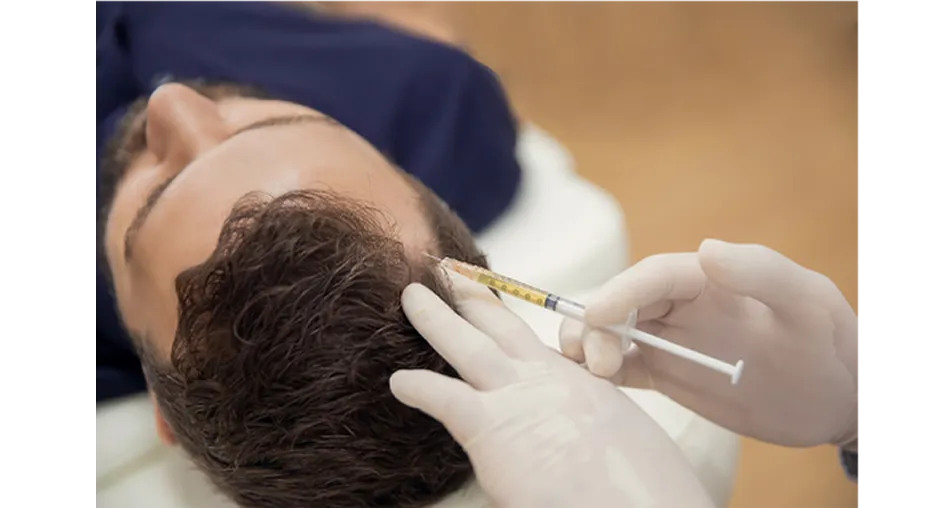
What hair PRP is and how it acts on the follicle
PRP is a concentrate of growth factors obtained by processing a sample of your own blood. That concentrate is then applied to the scalp, in the areas where hair has become weaker.
Its action targets the hair follicle: the aim is to stimulate it, slow down hair loss and support stronger hair. It is not about creating new follicles, but about working on those still present that have lost vitality.
An autologous treatment
Since it comes from the patient's own blood, PRP is 100% autologous. That characteristic is one of the reasons it is often considered for patients who want to support medical treatment of hair loss without introducing materials foreign to the body.
Who it is indicated for and who it is not
Hair PRP is usually considered for people with hair loss and weakened follicles, particularly when there is still follicular activity to work with. In early stages of hair loss it can help slow shedding and thicken existing hair, postponing or avoiding surgery.
It is not a universal indication. When loss is advanced and the follicle no longer responds, the approach may shift toward a hair transplant. There are also medical conditions and particular situations the physician must rule out beforehand.
The decision is not made from a catalog: Dr. Sandro Florez determines during the consultation whether PRP fits your case, on its own or combined with other measures in the plan.
What the procedure looks like at Dr. Sandro Florez's practice
Initial assessment
Everything begins with a medical diagnosis: examination of the scalp, history of the hair loss, background and factors that may be contributing. From there come the plan, the number of sessions and how they are spread over time, which the physician defines for each patient.
Collection and application
A blood sample is taken from the patient and processed to obtain the concentrate of growth factors. That plasma is then applied to the scalp, in the areas defined beforehand.
Follow-up
Follow-up visits make it possible to observe progress and adjust the plan. The length of each session and of the full protocol varies by case and is explained during the consultation in Bogotá.
Results: what to expect and when
Hair has a slow cycle, so changes are not immediate. With consistent treatment, shedding usually stabilizes within the first 2 to 3 months, and improvement in density and thickness is typically noticed between months 4 and 6.
In well-selected patients, PRP may help slow hair loss and support stronger hair. It does not guarantee a specific outcome and does not recover follicles that have already been lost; response varies from person to person depending on the type of hair loss and how long it has been developing.
It is worth remembering that androgenetic alopecia is a chronic condition: it is well controlled with continuous treatment, which means sustaining the plan over time rather than seeing it as a one-off procedure.
Aftercare and recovery
PRP is an outpatient procedure performed at the practice. Aftercare instructions are given in writing and adapted to each patient, since they depend on the treated area and the conditions of each case.
In general, the physician gives guidance on:
- Scalp care in the hours following the session.
- When to resume washing and your usual hair products.
- Physical activity and sun exposure, as the physician indicates.
- When to get in touch if any unexpected discomfort appears.
Following these instructions and attending follow-up visits is part of the treatment: the outcome depends as much on the application as on the patient's consistency.
Why to have it done by a physician in Bogotá
The first step with hair loss is always a medical diagnosis. Without it, there is a risk of treating a problem you do not actually have: androgenetic alopecia, telogen effluvium and other causes require different approaches.
Dr. Sandro Florez, a physician and surgeon specialized in aesthetic and hair medicine, practices in Bogotá (Calle 126 # 7-26, Torre 126 PH-1303). There, the assessment defines whether PRP is appropriate, how it fits with the rest of the plan and what can reasonably be expected.
Hair loss in women is also very common and has its own causes — hormonal, nutritional, postpartum; the plan is adapted to each case and the medical options are equally effective.
Combining PRP with other treatments
PRP rarely works alone. In early stages of hair loss, platelet-rich plasma, microneedling and medical treatment can slow shedding and thicken existing hair, postponing or avoiding surgery. When loss is already structural, it can accompany the strategy around a hair transplant.
Interest in regenerative treatments has grown in recent years; to understand that context, you can read about exosomes in regenerative medicine and about polynucleotides.
What to combine, in what order and how often is a medical decision made during the assessment, within the full range of treatments available.